


The rise of cloud computing, AI, IoT, and big data has resulted in the growing global demand for data processing and storage. This tendency has led to the emergency of two dominant infrastructure models, namely, traditional brick‑and‑mortar data centers and modular, prefabricated facilities. While both serve the same core function, they differ significantly in deployment speed, scalability, cost, and flexibility. This is why making the choice between them comes as a strategic decision for many organizations.
In the article, we’re going to discuss the specifics of both models, outline their features, and make a comparison between them. Being aware of this information will simplify the process of choosing a suitable infrastructure.
What Is a Traditional Data Center?
First of all, let’s regard each model separately to realize its uniqueness. Traditional data centers are purpose‑built facilities constructed on‑site. They often require extensive planning, civil works, and large upfront investment. Such facilities are typically designed for long‑term operation, with fully customized layouts, power distribution, and cooling systems.
However, while they offer high levels of customization and capacity, they also involve longer build times and less flexibility for rapid scaling. This shortcoming is essential for enterprises that are pressed in time and require urgent reaction.
To sum up, the key features of traditional DCs include:
- Stationary buildings. Such infrastructures are constructed as permanent structures, consisting of one or more rooms for equipment.
- Custom design. They are designed to meet specific customer requirements, including zoning into functional areas (server rooms, data storage, life support systems, etc.).
- Scalability. Scalability is possible, but requires significant time and resources for construction and expansion.
- Integration. Traditional DCs can be more difficult to integrate with complex existing infrastructure.
Thus, such solutions are suitable for long-term deployment and serving large enterprises, but they lag in terms of integration and scalability.
What Is a Modular Data Center?
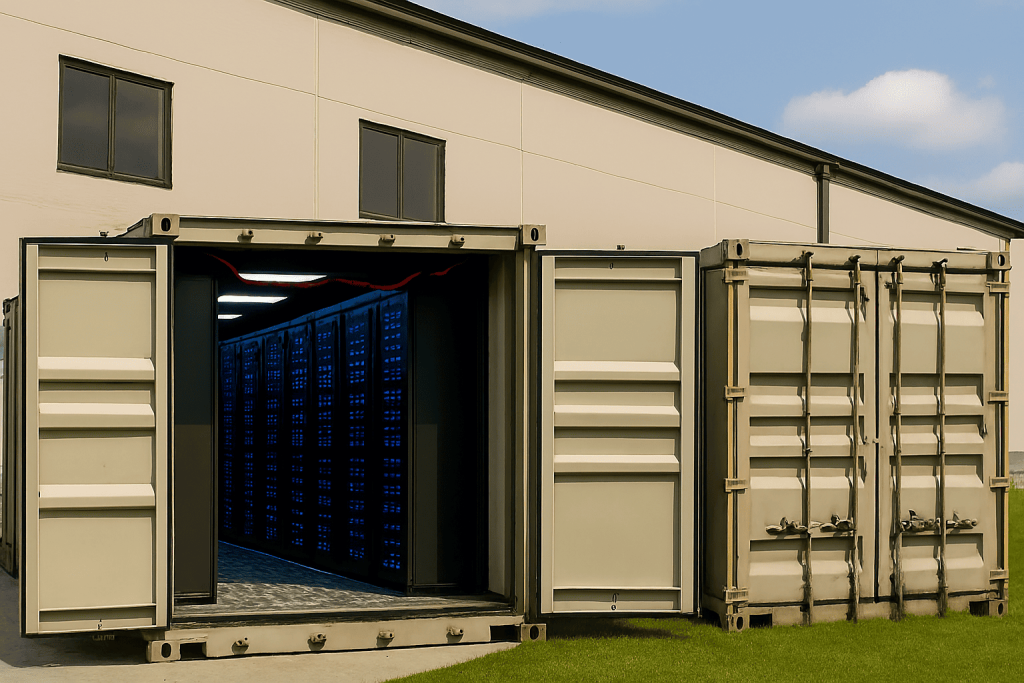
Modular data centers are prefabricated, factory‑built units. They are often containerized or skid‑mounted, which contributes to rapid deployment and easier integration into an existing infrastructure. Such constructions are designed for scalability, allowing organizations to add capacity in phases and updated facilities as business demands grow.
Modular designs can be standardized or semi‑custom. They are often used for edge computing, remote sites, or situations requiring fast deployment. Due to their compact, high‑density layouts, modular data centers require specialized server racks engineered for optimal airflow, space efficiency, and integration with prefabricated power and cooling systems.
Note that, being the leading supplier of server rack furniture, Sysracks will soon be launching a dedicated line of such racks, tailored for the unique requirements of modular deployments. Thus, customers will get access to specialized furniture that meet technical demands and is specifically developed for such purposes.
Thus, the main peculiarities of modular data centers include:
- Modular design. DCs consist of typical, standardized blocks or modules that may include servers, UPS, cooling systems, and other equipment.
- Quick installation and deployment. Such facilities are manufactured in factories and are only assembled and connected on site, which significantly speeds up the implementation process.
- Flexibility and scalability. They allow capacity to be increased as needed by adding new modules, providing flexibility and rapid response to changing needs.
- Mobility. Due to their block nature, modular data centers can be moved to another location if necessary.
- Standardization. Modular data centers are characterized by a high degree of standardization of components and quality, which simplifies maintenance and repair.
- Energy efficiency. Such facilities often use solutions such as inter-row air conditioning, which increases energy efficiency and reduces costs.
- Depending on the implementation. Modular data centers can be either stationary or containerized (mobile), located in standard shipping containers.
These specifics determine use cases and make such infrastructures more popular in today’s fast-evolving world. This is why such constructions replace traditional infrastructures by popularity.
Key Technical Differences Between Modular and Traditional Models
Although both models are designed to create secure and reliable IT environments, they differ in a number of technical aspects. These include:
| Technical Aspect | Traditional Model | Modular Model |
| Deployment Speed | 12–24 months to build and commission | Operational within weeks or months |
| Scalability | Requires major construction for expansion | Supports plug-and-play growth |
| Cost Structure | High upfront CapEx | Phased investment, potentially lower OpEx |
| Customization | Full design freedom | Standardized designs with optional customization |
| Energy Efficiency | May require retrofits for improved efficiency | Modern cooling and power systems with lower PUE |
| Portability | Fixed location | Can be relocated if needed |
| Compliance Security | Meets Tier certifications, longer compliance readiness | Meets Tier certifications, faster compliance readiness |
Why Does the Choice Matter?
Thus, businesses face the need to choose a suitable model for their facilities. Selecting the right model impacts operational agility, financial planning, and long‑term competitiveness. It’s essential to pick a suitable option to ensure smooth and effective running.
When choosing from these options, keep in mind that organizations with unpredictable growth or remote deployment needs may benefit from modular flexibility, while those with stable, centralized operations may prefer traditional builds. The wrong choice can lead to underutilized capacity, higher costs, or delayed market entry, so approach this step seriously and attentively. Do not hurry up and take enough time to analyze your business needs.
Use Cases for Each Model
Modular solutions seem to be superior to traditional DCs in every way: they are reliable, flexible, energy-efficient, scalable, and environmentally friendly. But can modules completely displace traditional data centers? Let’s consider some use cases that explain, in what situations both models will be perfect:
- Traditional Data Centers. They are suitable for large enterprise headquarters, government facilities, hyperscale cloud providers with predictable demand.
- Modular Data Centers. They are used for edge computing sites, disaster recovery facilities, temporary capacity boosts, remote industrial operations, and rapid deployment in emerging markets.
Although modular DCs have gained popularity, businesses are still hesitant to adopt modular architecture for various reasons, such as cost, reluctance to radically change the concept of an existing data center, and the low level of IT culture in some countries.To draw the line, note that modular data centers are an important stage in the evolution of digital infrastructure. They enable faster, more secure, and more efficient data delivery. Their role will only continue to grow as demand for real‑time applications increases. However, before you choose a facility, remember that to achieve maximum efficiency and reliability in modular solutions, it is essential to use specialized server racks. If you need such solutions for your business infrastructures, contact Sysracks for consultation and selection of the optimal racks for future projects.